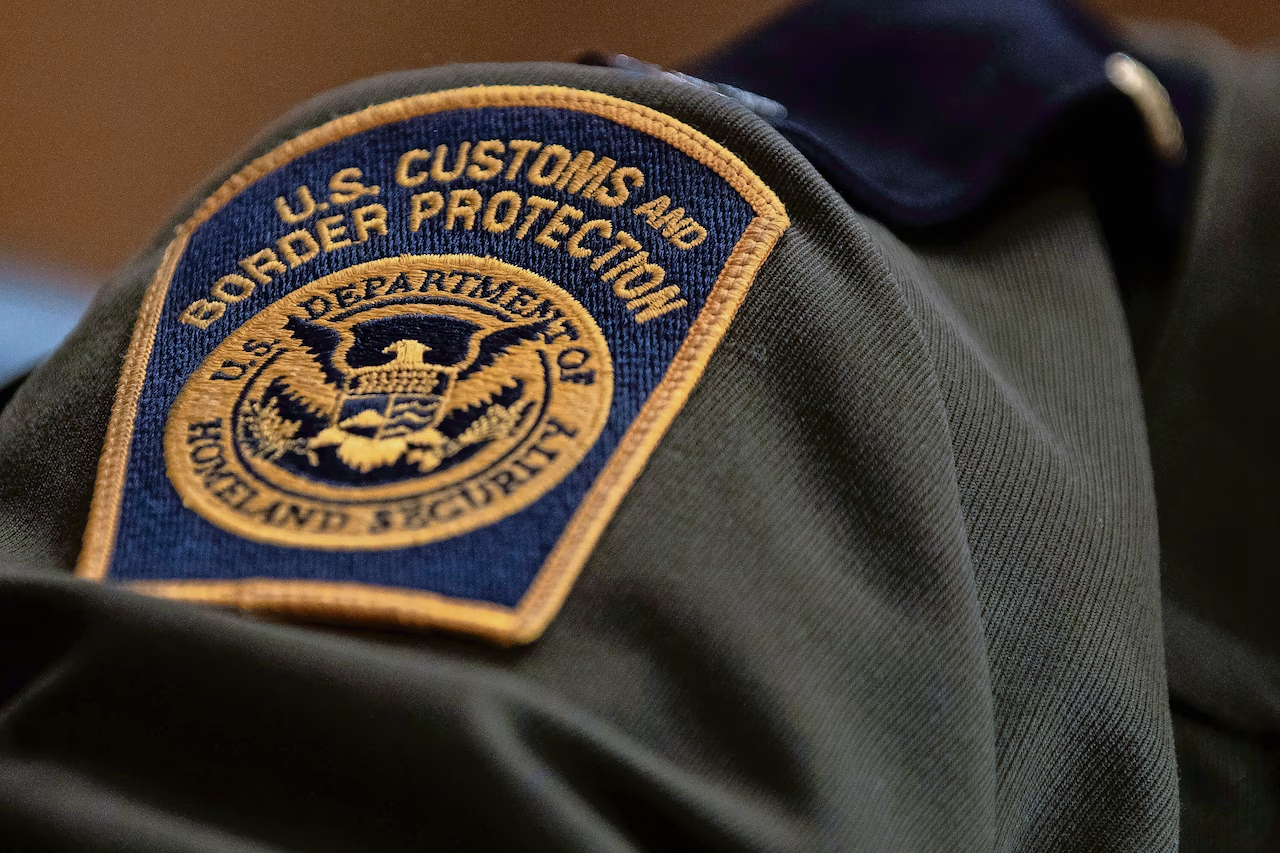
Portland, Oregon — U.S. Border Patrol agents, including members of a specialized unit known as the Special Operations Detachment, are operating in the Portland region and making arrests of immigrants suspected of having criminal records, federal officials confirmed this week.
The move has raised alarm among immigration advocates and civil rights experts, who warn that the agency’s growing presence far from the nation’s borders marks a troubling expansion of its authority.
Expanding Beyond the Border
U.S. Border Patrol, a branch of U.S. Customs and Border Protection (CBP), typically operates within 100 miles of international or coastal borders. Historically, the agency’s focus has been along the southern border with Mexico and, to a lesser degree, the northern border with Canada.
Also Read
However, under recent leadership, the agency’s reach has expanded dramatically. Gregory Bovino, the current Border Patrol chief, has spearheaded operations such as “Operation Midway Blitz” in Chicago and other major cities, including Los Angeles. Agents were also deployed to Portland in 2020 to suppress protests.
Now, Border Patrol officials claim that the Immigration and Nationality Act gives them legal authority to act “anywhere” within the United States — a position that immigration law experts say represents a major shift in federal enforcement policy.
Concerns Over Accountability and Use of Force
Civil liberties groups, including the American Civil Liberties Union (ACLU), have voiced concern over the agency’s increasing operations in urban centers.
“We’ve long had concerns with Border Patrol in terms of use of force,” said Sarah Mehta, senior attorney in the ACLU’s Equality Division. “There’s a kind of lawlessness to the agency that’s deeply problematic. They see themselves more as a frontier force than a professional law enforcement agency.”
The agency’s record includes numerous reports of aggressive behavior during enforcement actions. Videos have shown agents drawing rifles, pointing guns at civilians, and using excessive physical force.
Limited Transparency Around Portland Operations
A CBP spokesperson confirmed Border Patrol’s activities in the Portland area but declined to provide details on the operation’s timeline, staffing, or objectives.
“U.S. Border Patrol agents operating in the Portland area are targeting and arresting criminal aliens who continue to violate our nation’s immigration laws,” the spokesperson said in an email. “As a matter of policy, CBP does not share staffing strength or operational details.”
While the total number of arrests in Oregon remains unknown, immigration enforcement across the state surged in October, with over 300 arrests reported in that month alone.
Local Incident Raises Questions
One recent case in Sherwood, a Portland suburb, has intensified scrutiny. On November 3, Israel Garcia was detained after dropping off a relative at a private home. According to his brother, Jairo Garcia, U.S. Border Patrol agents followed them onto private property and forcibly removed Israel from his vehicle.
Video footage shared by the family shows multiple unmarked vehicles in the driveway and an agent identifying himself as being with Border Patrol. Jairo Garcia said his brother suffered two broken ribs during the encounter, although that portion of the incident was not captured on video.
“Why do they have to hurt people?” he asked in Spanish.
Israel Garcia was later transported to a hospital after feeling unwell in custody. Due to privacy laws, the ambulance company declined to provide further details.
Legal Grounds and Broad Authority
CBP maintains that the Immigration and Nationality Act authorizes agents to question individuals, arrest them without a warrant if suspected of being in the country unlawfully, and search vehicles or vessels on reasonable suspicion of immigration violations.
“Their ability to operate nationwide ensures Border Patrol can enforce immigration laws, combat smuggling, and address national security threats anywhere in the United States,” a CBP spokesperson said.
However, immigration law experts dispute this interpretation. Ahilan Arulanantham, co-director of the Center for Immigration Law & Policy at UCLA, said that while Border Patrol has long claimed jurisdiction in coastal cities like Portland and Los Angeles, large-scale enforcement actions in these areas are a new development.
“In practice, they almost never conducted significant operations in these places until now,” he said. “So, this is a significant shift.”
Constitutional Concerns
Arulanantham explained that the Fourth Amendment protects people from unlawful searches and seizures. Just like police officers, Border Patrol agents may ask questions on the street, but individuals are not required to respond.
“That’s where the right to remain silent comes from,” he said. “People are free to ignore questions and walk away.”
He added that in Los Angeles earlier this year, Border Patrol agents reportedly stopped individuals and refused to let them go even when they declined to answer questions — actions he described as “clearly illegal” under the Constitution.
Because of these incidents, Arulanantham said it has become difficult to advise people on how to interact with immigration authorities, as “the law is not being followed by the government.” Still, he emphasized that individuals have the constitutional right to remain silent, and some who have challenged violations in court have won.
Racial Profiling and Human Rights Concerns
According to Mehta of the ACLU, Border Patrol has a long history of racial profiling and use of excessive force during “roving patrols.” She said the agency has repeatedly failed to report critical information to Congress, including data on deaths and use-of-force incidents.
The issue of racial profiling was further complicated in September when the U.S. Supreme Court declined to block certain immigration sweeps, effectively allowing some lower court rulings in Los Angeles that found such practices likely unconstitutional to stand.
“Border Patrol has committed egregious human rights abuses against immigrants and migrants,” Mehta said. “Now we’re seeing those same tactics used within American cities — policing that is discriminatory, aggressive, and dangerous for local communities.”
A Growing Federal Presence
The growing deployment of Border Patrol agents in urban areas — far from any international boundary — signals a broader shift in federal immigration enforcement strategy. Once largely confined to border zones, the agency’s activities now increasingly mirror those of traditional law enforcement, but with less oversight.
For many advocates, this trend raises a fundamental question about the balance between immigration enforcement and civil rights. As Border Patrol expands its reach, communities across the country — including Portland — are confronting what it means to live in a nation where the “border” seems to be everywhere.